The River Is Talking—Here's How to Listen: Reading Au Sable Water Like You've Fished It for Years
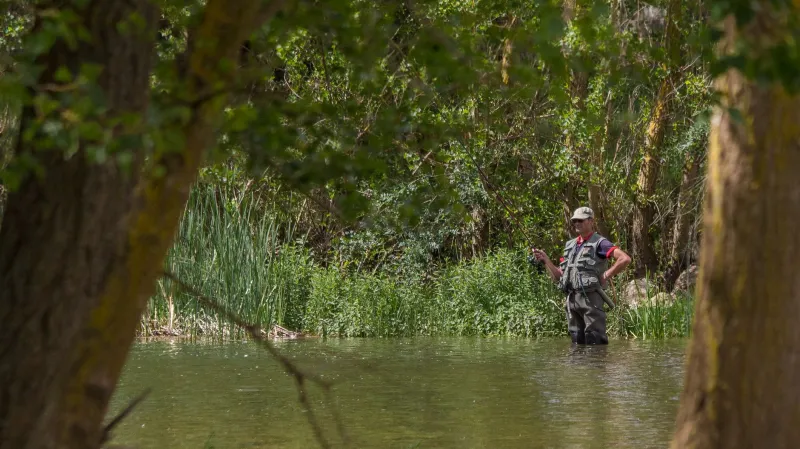
The Au Sable will humble you if you let it. It looks approachable—a winding, spring-fed ribbon through northern Michigan's jack pine plains, not the roaring whitewater you might picture when someone says 'trout river.' But that gentle appearance is deceptive. The Au Sable has layers, and the anglers who consistently find fish here are the ones who've learned to read them.
If you're making your first trip to the river—or your fifth, but still going home wondering where the fish were—this is the framework you need.
Start With What Makes the Au Sable Different
Before you can read this river intelligently, you need to understand what drives it. The Au Sable is a spring-fed system. That's not just a fun fact—it's the most important thing about its hydrology. Hundreds of cold groundwater springs feed the river continuously, which is why water temps stay relatively stable even during heat waves, and why the river runs clearer than most.
That clarity is both a gift and a challenge. You can often see fish. They can definitely see you. Approach matters, presentation matters, and reading the subtle current variations matters more than it would on a stained, faster river where you can get away with sloppiness.
The Au Sable also has a relatively gentle gradient through most of its fishable sections. It doesn't race—it meanders. Current speed varies more from bank to bank and depth to depth than from upstream to downstream. Understanding that lateral variation is the key to finding where fish hold.
Current Seams: The First Thing to Find
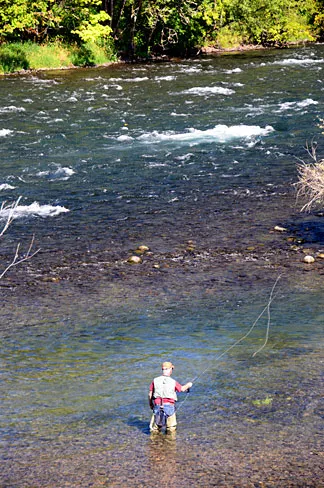
A current seam is where fast water meets slow water. On the Au Sable, these form constantly—around bends, off the tips of gravel bars, behind any obstruction in the flow. Seams are prime real estate for trout because they solve a basic biological equation: the fish sits in the slow water, expending minimal energy, while the fast water on the other side delivers a conveyor belt of food.
Look for the visible line on the surface where water speeds diverge. It might be a subtle color shift, a slight riffling where currents collide, or a foam line tracking downstream. That foam line is especially useful—surface foam accumulates in the slower current, and it tends to collect exactly where drifting insects are traveling. Where the foam goes, the fish often are.
When you identify a seam, your goal is to present a fly drifting naturally in the fast lane while your leader and line sit in the slower lane. This requires mending—repositioning your fly line upstream after the cast to prevent drag from pulling your fly off course. On the Au Sable, drag-free drifts aren't optional. They're mandatory.
Fallen Timber, Undercuts, and Why Trout Love Them
The Au Sable flows through a forested corridor, and that means deadfall. Logs, root wads, and brush piles fall into the river constantly, and they're among the most productive fish-holding structures you'll encounter—and among the most intimidating to fish.
Here's the logic: fallen timber breaks current, creates shade, and provides overhead protection from predators. Brown trout in particular are structure-oriented fish. They don't want to be exposed in open water when they can tuck under a log with current pushing food past their nose.
Fishing tight to timber requires accurate casting and a willingness to lose flies. Accept the second part. The fish holding in that structure are worth the occasional snag. Aim for the upstream edge of the obstruction and let your fly swing naturally into the shadow zone. A short, controlled cast is almost always better than a long, ambitious one here.
Undercut banks are similar. The Au Sable's sandy, loamy banks erode over time, creating horizontal caves along the waterline. These undercuts are prime brown trout territory—especially larger fish that have learned to be cautious. You often can't see into them from a standing position in the river. The tell is the bank itself: if it overhangs the water by more than a foot or so, there's likely a cut behind it. Approach from downstream, stay low, and cast up-and-across so your fly drifts naturally into the undercut's shadow.
Gravel Runs and Riffle Transitions
Not all Au Sable fish are hiding under cover. Gravel runs—sections of moderate depth with a clean, rocky bottom and consistent current—are feeding stations, especially during hatches. When insects are emerging, trout move onto these runs and rise predictably. Learn to identify them: they're often slightly shallower than surrounding water, with a broken surface from current passing over the substrate.
The transition zone between a riffle and a pool is another high-percentage location. As faster water dumps into a pool, it creates a bubble line and a depth change. Trout stack at this transition to intercept food being washed off the riffle. On the Au Sable, these spots are worth spending time on before moving on.
Dam Releases and Daily Flow Patterns
The Au Sable's flow isn't entirely natural—several impoundments along the river system affect water levels and temperatures in ways that directly influence fish behavior. Mio Dam and Loud Dam are the most relevant for anglers fishing the main stem.
The practical takeaway: when dam releases increase flow, fish often push toward the edges of the river. Faster, higher water makes mid-channel holding less efficient, and trout will move to softer water near the banks, behind structure, or in back-eddies. When flow drops back, fish may return to mid-river feeding lanes.
Check flow data on the USGS stream gauge for the Au Sable at Mio before your trip. It's free, it takes two minutes, and it tells you whether you're walking into rising, falling, or stable water—information that shapes your whole approach for the day.
Putting It Together: A Simple Approach for New Water
When you step into an unfamiliar stretch of the Au Sable, don't just start casting. Take five minutes first.
Stand back from the bank and watch the surface. Find the foam lines and seams. Identify the obvious structure—the logs, the undercuts, the gravel transitions. Note the current speed variations across the width of the river. Ask yourself where a fish would sit to intercept food with the least effort.
Then start at the bottom of the section and work upstream, presenting to likely water before you wade through it. The Au Sable's clarity means wading carelessly through a run before you've fished it is a great way to spook every fish in it.
Reading water is a skill that compounds over time. Every trip, you'll pick up something new—a subtle eddy you'd have walked past before, a depth change you can now feel through your boots. The anglers who fish the Au Sable best aren't necessarily the ones with the most expensive gear. They're the ones who've learned to pay attention.
The river is always telling you something. Start listening.