Mud, Flow, and the Flies That Actually Work: Cracking the Au Sable's Spring Runoff Code
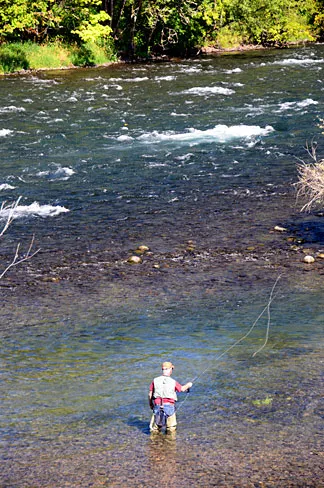
Photo: Gary Halvorson, Oregon State Archives, Attribution, via Wikimedia Commons
Spring on the Au Sable doesn't announce itself politely. One morning the river is running low and clear, and by afternoon a rain event upstream has pushed the gauge at Grayling up six inches and turned the water the color of weak coffee. Michigan's snowmelt and April storm cycles make the Au Sable one of the most dynamic trout rivers in the Midwest during this window — and that's exactly why so many anglers show up with the wrong flies.
If you've ever driven three hours from Detroit or Grand Rapids, rigged up your favorite Hex imitation or a size 16 Parachute Adams, and spent the day wondering where the fish went, you already know the frustration. The river didn't stop holding trout. You just haven't learned to speak spring yet.
Let's fix that.
Why Your Summer Box Fails in April and May
The Au Sable's upper and main branches run cold and clear for most of the season, which is exactly what makes it legendary dry-fly water. But during runoff, that clarity disappears. Visibility drops, current speed increases, and trout shift their feeding behavior dramatically. They're not rising to size 18 midges when the river is pushing three times its normal volume and visibility is measured in inches.
High, discolored water does a few things that matter to fly selection. First, it concentrates fish. Trout burn more energy holding in fast current, so they push into slower seams, undercut banks, and eddies behind structure. Second, it forces them to feed opportunistically on larger, more visible food items. Third, it mutes their ability to inspect flies closely — which is actually good news if you're willing to go bigger and bolder.
The mistake most visiting anglers make is sticking with what they know. The summer playbook is a comfort zone. Breaking out of it requires understanding which phase of runoff you're actually fishing.
Phase One: Rising Water and Stained Conditions
This is the hardest phase to fish and the one most people give up on too quickly. When the gauge is climbing and the river is running anywhere from slightly off-color to downright murky, your goal is to get a fly in front of a trout's face with enough visual contrast to trigger a strike.
Go big, go dark, go weighted. Size 8 and 10 Woolly Buggers in black or olive are your best friends here. Strip them through the slower current seams near the bank. A heavy Hare's Ear nymph or a Pat's Rubber Legs in brown or black, dead-drifted tight to structure, will also produce. Don't be shy about adding split shot — getting down matters more than presentation finesse when the water is this high.
Streamers that push water and create vibration, like a Conehead Muddler or a Double Bunny in natural colors, give trout something to track even when visibility is limited. Fish them slow. Let the current do the work.
Phase Two: The Clearing Window
This is the phase most anglers miss because they're not paying attention. As a runoff event peaks and begins to drop, there's often a 12-to-48-hour window where the river clears faster than it drops. The water is still higher than normal, but visibility opens up to two or three feet. Trout that were hunkered down start actively feeding again.
This is when you want to be on the water.
Switch to medium-sized nymphs — size 12 to 14 — in earthy tones. A Pheasant Tail with a tungsten bead, a Copper John in red or copper, or a Zebra Midge dropper off a larger attractor nymph can be deadly during this transition. The fish are hungry and the competition from other anglers is low because most people have already gone home.
On warmer afternoons during this phase, watch for early season hatches. Hendricksons begin emerging on the Au Sable as early as late April, and a size 14 Hendrickson dry or an emerging soft hackle fished just below the surface can produce explosive takes from fish that have been sitting out the runoff.
Phase Three: Dropping and Recovering
As flows normalize and the river returns toward summer levels, the fishing transitions into something more familiar — but it's still not quite summer. Water temperatures are still cold, fish are active but not in their typical summer lies, and the hatches are just getting started.
Early Blue-Winged Olives are a staple during this phase. A size 16 to 18 BWO parachute or a Sparkle Dun in olive-gray will work on rising fish during overcast afternoons, which is exactly the light BWOs prefer. Pair it with a RS2 or a Pheasant Tail nymph as a dropper if you're not seeing consistent surface activity.
Caddis also begin showing up in earnest as the river drops and warms. An Elk Hair Caddis in tan or olive, sizes 14 to 16, is a legitimate all-purpose fly for this window. If fish are refusing the dry, swing a soft hackle wet fly through the tail of a run — it imitates an emerging or drowned caddis and rarely gets ignored.
Gear Adjustments Worth Making
Beyond fly selection, a few equipment tweaks make spring fishing more productive. Bump your tippet up to 3X or even 2X when you're fishing streamers in high water — fish aren't leader-shy and you'll lose fewer flies to the structure you need to be fishing near. A strike indicator system with adjustable depth is more useful than a fixed euro-nymphing rig when the water column is changing day to day.
Waders with good grip soles are non-negotiable in spring. The Au Sable's bottom is slippery under normal conditions, and runoff adds debris, uneven flow, and soft spots that can catch you off guard. Wade conservatively and carry a wading staff if you're not used to moving water at higher flows.
The Payoff
Spring on the Au Sable isn't a waiting game. It's an invitation to learn the river in a completely different mood — one that rewards anglers who adapt. The crowds are thin, the fish are feeding, and the window between ice-out and summer lockdown is short enough that every trip counts.
Stop waiting for the river to come to you. Meet it where it is.
Stop by the shop before your next spring trip and we'll tell you exactly what's been working. The gauge doesn't lie, and neither do the guides who fish this stretch every week.