Reading the Pulse: How Mio and Alcona Releases Rewrite the Au Sable Mid-Drift

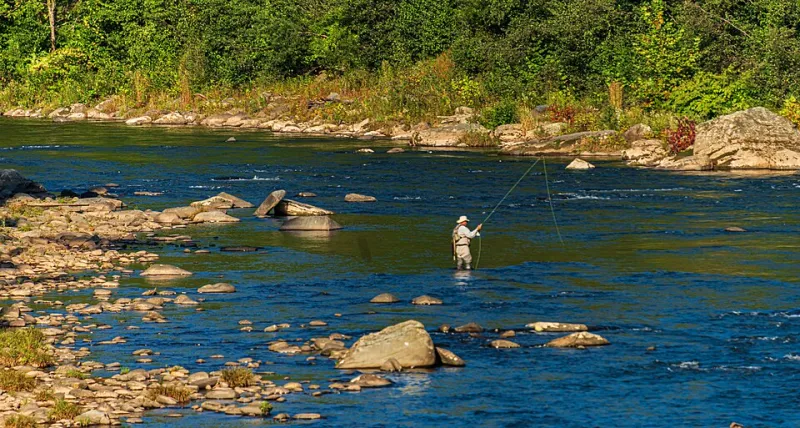
Photo: fly fisherman reading river gauge data on phone beside Michigan river at dawn, via cdn.pixabay.com
Most anglers fish the river that happens to be there when they show up. A smaller, quieter group fishes the river that's about to be there — and they catch more trout for it.
Mio Dam and Alcona Dam turn the main stem into a partly scheduled river. Water moves through the turbines when the grid asks for it, which means discharge, depth, clarity, and current speed can all shift while you're still standing in the same run you waded into an hour ago. Learn to read that schedule and you stop getting surprised. Better still, you start using the pulses instead of cursing them.
The River Behind the River
Nothing about the Au Sable's dam chain is hidden. It just isn't obvious. Generation is driven by demand, so mid-morning and late afternoon on a hot weekday look nothing like a quiet Sunday at dawn. Downstream of each dam, the leading edge of a release moves as a wave — a soft, fast bulge of water that lifts the river, pushes debris off the banks, and scrambles whatever the trout thought they had figured out.
That bulge is the whole game. Get ahead of it and you fish water that's stable and lightly pressured. Get caught behind it and you spend the day watching your nymph drag at 40 percent more speed than when you tied it on.
Three Numbers Worth Knowing Before You Leave the House
You don't need a hydrology degree. You need a bookmark and thirty seconds.
- Discharge in cubic feet per second. The Mio gauge (USGS 04136500) is the one to watch for the stretch below Mio Dam. The lower-river gauge near Au Sable gives you the picture once everything has blended together.
- Gage height. Roughly the depth of the river at that station. Useful for spotting a rise you'd otherwise miss while rigging up.
- The shape of the line, not the number. A single reading tells you almost nothing. The trend over the last six hours tells you everything.
What the Hydrograph Is Actually Saying
Four shapes cover most days on the Au Sable.
Flat. A horizontal line means steady water. Fish it without overthinking. Trout hold in predictable lies and eat a well-drifted fly.
Stair-stepping up. Successive bumps mean peaking is underway. The water will keep climbing for a while yet. This is your cue to move to slower, deeper water or to a stretch the release hasn't reached.
A hard ramp with a sharp corner. The leading edge is moving. Depending on how far you are below the dam, you've got anywhere from twenty minutes to a couple of hours before it arrives at your feet.
The long slide down. The falling limb is the most underrated part of the cycle. Current eases, clarity improves, and trout slide back out to feed on the edges they abandoned on the rise.
Timing a Float
On a drift, you want to launch just behind the leading edge, not in front of it. Put the boat on the water as the pulse passes, and you're following a wave of freshly disturbed water that's flushed baitfish, dislodged nymphs, and rearranged the bank structure. Trout in freshly rising water aren't always easy — they're often tight to cover — but the first angler behind the pulse sees water nobody has touched all day.
If you're launching ahead of the pulse, plan your takeout to account for the extra speed. A float that runs five hours at base flow can lose an hour at peak. Build that slack into your schedule instead of arguing with a shuttle driver about it.
Timing a Wade
The calculus is simpler and the stakes are higher. Wade the low window early, before the release arrives, and pick water you can exit quickly. Then — and this matters — read the river while you're standing in it. Watch the rocks at the edge of your peripheral vision. Watch the dark stain creeping up a gravel bar. The river usually tells you before it shoves you.
If the pulse catches you, don't try to cross to the far bank. Turn, move downstream and diagonally toward the nearest shore, and keep your feet under you. Fighting rising current across a channel is how wading belts end up on the news.
Adjusting When the Water Changes on You
A release doesn't just raise the water — it wrecks your presentation and then hands you a new one.
When it's rising and slightly off-color, go bigger and simpler. A single heavy stonefly nymph, a woolly bugger on a sink tip, or a streamer swung through a soft seam will outfish a delicate dry-dropper by a wide margin. Shorten your leader, bump the tippet up a size, and stop worrying about drag — the fish aren't.
When it's high and chocolate, the honest answer is that fishing gets hard. Find slack water behind structure, fish tight to the bank, and expect a slow grind rather than a numbers day.
When it's dropping and clearing, get back to precision. The last two hours of the falling limb are when Au Sable browns get careless. Fish will move to the inside of the bend and the cushion behind boulders, and a pair of flies — one heavy, one small and dark — covers both the fish that are still sulking and the ones already feeding.
The Habit That Beats Any Fly Pattern
Check the gauge the night before. Check it again over coffee. Check it once on the water before you commit to a crossing. That's it. Three looks, thirty seconds each, and you'll spend your season fishing water instead of reacting to it.