Beyond the Obvious: Why Seasoned Au Sable Anglers Swear by Tandem Rigs No Matter the Conditions
There's a moment most Au Sable regulars can point to — some afternoon on the Holy Water, or maybe a long float through the upper river — when fishing two flies stopped being a trick and started being a way of thinking. It's not about doubling your odds in some mechanical sense. It's something more fundamental than that.
Experienced anglers on this river fish tandem rigs even when conditions don't demand it. Even when the hatch is obvious and the trout are locked onto a single bug. Even when a one-fly approach would be perfectly fine. Why? Because the two-fly setup teaches you things a single pattern simply can't.
It's a Live Experiment, Every Single Cast
Here's the thing about fishing two flies simultaneously: you're running a real-time comparison test on every drift. One pattern might be sitting higher in the water column, the other riding lower. One might be a size 16, the other a 20. You're not guessing what the fish want — you're asking them directly, and they're answering with every take (or refusal).
Guide and longtime Au Sable regular Marcus Hale puts it plainly: "When I'm fishing one fly and I'm getting refusals, I'm just guessing at solutions. With two flies, the river tells me which direction to go. If the dropper is getting hit and the lead fly isn't, I know something about depth or profile. If neither is working, at least I've eliminated two variables instead of one."
That kind of structured feedback loop is hard to replicate any other way. It turns a slow afternoon into a productive one — not because you're catching more fish necessarily, but because you're learning faster.
What It Does to Your Casting
This part surprises a lot of people: fishing a tandem rig consistently makes you a better caster, even when you go back to a single fly.
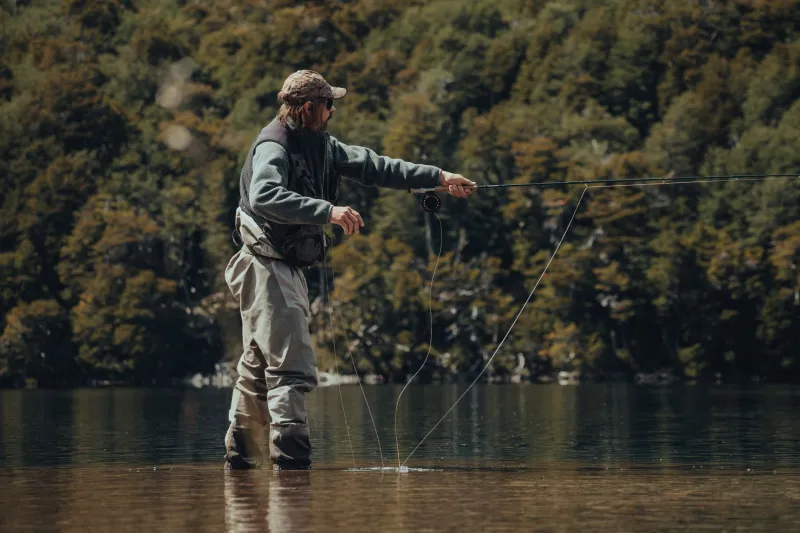
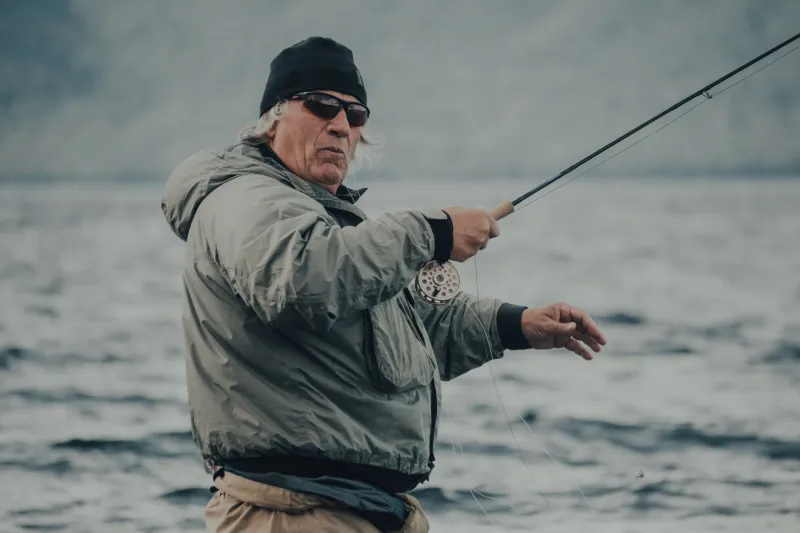
The physics of it are straightforward. Two flies on a leader demand more precision. The system is heavier, the timing window tightens, and any slop in your loop gets punished with tangles. You learn quickly to slow your backcast, load the rod more deliberately, and stop muscling the forward stroke. The feedback is immediate and honest.
Competitive angler and Au Sable devotee Carla Stinson, who fishes local club events and has guided out of Grayling for several seasons, describes it this way: "I tell newer anglers to fish tandem rigs not because I think they need two flies, but because I know it'll fix their casting. You can't be sloppy. The rig won't allow it. After a season of fishing two flies regularly, their single-fly presentation gets noticeably cleaner."
There's also the mending piece. Managing a two-fly rig on the Au Sable's current — especially in sections where the water braids and speed changes across a single lane — forces you to think about your line in three dimensions. You start mending earlier, more deliberately, and with a clearer picture of what the flies are actually doing downstream.
Reading Water Differently
Fishing tandem rigs changes where you look when you approach a stretch of river. With one fly, you're often hunting for the most obvious lie — the seam, the log, the undercut bank. With two flies, you start thinking in layers. Where is the surface activity relative to where the subsurface feeding might be happening? Is the film the right place for the lead fly, or should I flip the rig and put the dry on top of a nymph?
That kind of layered thinking rewires how you read the Au Sable over time. You stop seeing the river as a flat surface and start seeing it as a column — a whole system of depth, speed, and structure that fish are moving through vertically as much as horizontally.
Hale again: "I've had clients who fished the Au Sable for years with one fly and thought they knew it well. We put them on a tandem rig for a full day and by the afternoon they're pointing out water they never noticed before. They start seeing the river in a new way. That's the real gift of the two-fly approach."
The Problem-Solving Mindset
Maybe the most underrated benefit of committing to tandem rigs is what it does to your head. Fly fishing has a way of making anglers superstitious — you find something that works and you hold onto it, sometimes past the point where it's still working. The two-fly setup pushes back against that tendency.
When you're always fishing two patterns, you're always in a mode of comparison and adjustment. You're less likely to get stuck on a single idea about what the fish want. You stay curious longer. And on a river as dynamic as the Au Sable — where conditions can shift from a Hendrickson hatch to a Caddis blitz to dead-calm technical water in the span of a single outing — that adaptability matters enormously.
Stinson puts it in competitive terms: "In tournament fishing, the anglers who adjust fastest usually win. Tandem rigs train that muscle. You're never fully committed to one answer. You're always gathering data."
That same mindset carries across seasons, too. The angler who's spent a summer learning to read feedback from two flies is better equipped to problem-solve a cold October morning when the river looks completely different and the fish are behaving in ways that don't match anything from August.
What to Actually Fish
If you're new to tandem rigs on the Au Sable, the easiest entry point is a dry-dropper setup: a buoyant dry fly up front (a Elk Hair Caddis or a Parachute Adams are reliable starting points) with a small nymph or soft hackle trailing 12 to 18 inches behind on a tippet section. This combo lets you cover the surface and the subsurface simultaneously while keeping the rig manageable.
As you get more comfortable, you can experiment with two nymphs at different depths, or a streamer with a smaller soft hackle trailing off the bend hook. The Au Sable's variety of water — from the broad, slow pools of the mainstream to the tight, fast runs of the upper branches — gives you plenty of room to test different configurations and figure out what the two-fly approach reveals about each section.
We stock a full range of tandem-ready leaders, tippet, and fly combinations in the shop — and if you want a local opinion on what's been working lately, we're always happy to talk through what the river's been doing.
The Deeper Point
Fishing two flies on the Au Sable isn't a gimmick, and it's not just about covering more water. It's a discipline — one that builds better mechanics, sharper observation, and a more flexible mind. The anglers who've stuck with it long enough will tell you it changed how they fish everything, not just this river.
The Au Sable rewards that kind of investment. It's a technical river with a lot of personality, and the more tools you have for listening to it, the more it gives back. A second fly on your leader is one of the simplest ways to start hearing it more clearly.